

By Rebecca Witherspoon, July 8, 2025
Abuse doesn’t always come with bruises. It doesn’t always scream at you. It doesn’t always throw punches or leave visible marks. Sometimes, it’s quiet. Covert. Calculated. It unfolds through manipulation, emotional exhaustion, and the relentless erosion of reality.
That’s why we need to talk about how and why many victims choose to protect themselves, as well as two popular tactics abusers use to maintain control and keep the narrative in their favor—not just in homes and relationships, but in courtrooms, schools, churches, politics, and public life. Don’t be surprised if you find yourself nodding in agreement or thinking of personal examples as you read through this blog. But be forewarned: this one will be messy, uncomfortable, and highly personal.
Gray Rocking: The Survivor’s Last Resort
“Gray rocking” is a technique that many survivors use to protect themselves. It where victims or those trying to protect victims become emotionally unresponsive—boring, even—so that an abuser loses interest in them. Survivors often use this strategy because sometimes it’s the only way to protect themselves—despite what some may think, leaving an abusive situation is not always an option. Gary rocking becomes an important survival skill, because every emotional reaction can be a trigger point for the abuser. The abuser thrives on chaos, and any engagement—even defensiveness—feeds the cycle of abuse.
Gray rocking is self-preservation, not coldness. But when outsiders—teachers, friends, community members—see the survivor as “distant” or “unemotional,” they often misread the signals. They can fall into blaming the victim for the abuse. They might even call them unstable, bitter, or dramatic. All while the abuser plays the charismatic, composed figure who “just wants peace.”
Tactic #1 – Gaslighting: The Abuser’s Favorite Game
Gaslighting is the intentional distorting or twisting of the truth so thoroughly that the victim, or those trying to protect them, begin to question their own memory, sanity, and perception of events. It’s not just lying; it’s psychological warfare. It’s making the victim feel like they’re overreacting, misremembering, or even going crazy.
“I never said that.”
“You’re too sensitive.”
“You’re imagining things.”
“You’re making me out to be a villain.”
Does that sound familiar?
Abusers weaponize this tactic in both personal relationships and public life. They cast doubt on the facts. They undermine witnesses. They rewrite the narrative. They cry “character assassination” when held accountable. And they manipulate systems and institutions to help them get away with it.
Often the only way to combat this tactic is to maintain very clear records whenever possible—things like screenshots, recordings, etc. But confronting the gaslighting must be done cautiously to reduce the risk of further victimization.
Tactic #2 – Guilt: The Manipulative Glue
Guilt is one of the most insidious tools in an abuser’s arsenal—not because it’s loud or violent, but because it’s quiet, sticky, and often effective. It clings to survivors long after the abuse ends.
Abusers weaponize guilt to deflect attention from their behavior and keep the focus on the victim’s perceived failings. “You’re tearing this family apart.” “You’re so unforgiving.” “You’ll ruin my reputation.” “You’re doing this to hurt me.” These guilt trips aren’t random—they’re calculated. They’re meant to make the survivor feel responsible not just for the abuser’s feelings, but for the entire situation.
Over time, survivors internalize those messages. Even when they try to speak the truth, they’re haunted by self-doubt. Am I being too harsh? What if I’m wrong? Maybe I should just stay quiet to keep the peace. This is how guilt becomes the glue that binds victims to silence—and keeps abuse hidden in plain sight.
But let’s be clear: speaking up is not an act of vengeance. It’s an act of survival. This series isn’t about bitterness—it’s about breaking free from manipulation, reclaiming the narrative, and making space for accountability and healing.
Institutions Can Enable Abuse
In a perfect world, institutions—like schools, courts, or local governments—should serve as neutral protectors of fairness, due process, and accountability. But in reality, these same institutions can be manipulated to shield abusers and re-victimize those who have already been harmed. Instead of standing with victims, they can instead protect the status quo. Especially when decision-makers are unfamiliar with the tactics of abuse, are politically motivated, or are simply conflict-averse, the result is often harmful neutrality. They claim they’re “staying out of it” or “not taking sides,” but what that really means is refusing to acknowledge truth when it’s uncomfortable or politically inconvenient.
In my own experience, the schools re-victimized my family by refusing to believe my children—not because there was no evidence, but because they didn’t like the personalities of my children. Our church, meanwhile, tried to spiritualize the trauma, suggested that we should forgive the abuser, and even tried to blame the children for what was done to them. The abuser, a well-known ministry leader, was more than willing to play the part of the misunderstood victim. The institutions gave him cover and never once reached out to us to help us heal.
And now? That same dynamic is playing out in our local political arena.
Certain people are attempting to elevate someone with a troubling background into public office, despite the public record. It’s almost as though the red flags make this person appear to be a useful puppet who can be easily manipulated and controlled by those behind the scenes pulling the strings. And those people are attacking anyone who dares to point out the truth. Using guilt. Using gaslighting. Weaponizing community loyalty, a sympathetic “victim,” and spinning the truth into a smokescreen.
A Local Scandal Reveals That This Is Bigger Than Just One Family
As others chose to open a door I wasn’t sure I wanted to open, it seems the time has finally come to make something painfully clear. The same tactics that we see in abusive relationships are now playing out in real time in our local public and political arenas—and too many people are falling victim to the gaslighting and manipulation.
Take the current case involving Alicia Williams, who ran as a write-in candidate in last spring’s local Village Board race and has recently declared that she will be running as a registered candidate in the impending recall election in my village in mid-September. A recent post on an anonymous Facebook page called “Truth of the Village”—which made its debut during last spring’s race and actively promoted her write-in campaign while spreading disinformation and defamatory accusations against a couple of incumbents who were running for re-election—is a prime example of the use of both gaslighting and manipulative guilt to deflect the focus off Alicia and onto those who called her credibility into question (see screenshot below—the author of this post sounds hauntingly familiar—oink).
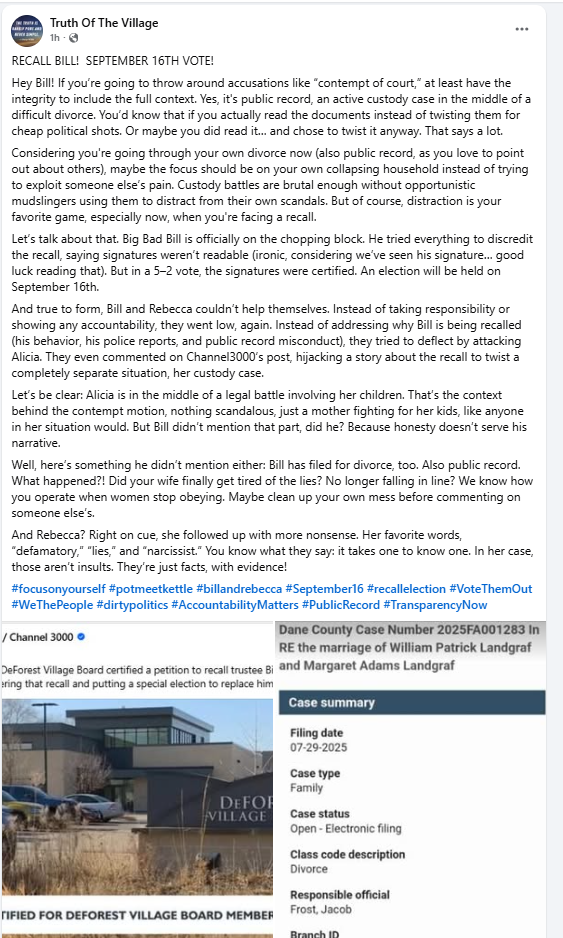
First, it’s interesting that “Truth” of the Village somehow thinks that Bill filing for divorce equates to his wife getting “tired of the lies.” You may want to rethink your logic there. Typically it’s the one who files that is “tired” of something, not the other way around. That’s gaslighting at it’s finest.
Second, Alicia is not in “an active custody case in the middle of a difficult divorce.” More gaslighting at its finest. The divorce was final more than a decade ago, and Alicia has shared 50/50 custody with her former spouse for many years.* Third, the contempt of court motion referenced in the post isn’t about “a mother fighting for her kids.” Another fine example of gaslighting. It’s actually about an apparent pattern of behavior by Alicia that suggests a troubling disregard for legal boundaries and court orders.**
According to public records, Alicia took her two sons to a foreign country without notifying their father or receiving his permission, without informing their school, and without securing court approval. The public record also indicates that she even asked her children to lie about the trip. If the court does find her in contempt, this isn’t just a violation of a custody order—it could even rise to more serious legal consequences under both state and federal law. Some jurisdictions take this type of behavior very serious.
But instead of acknowledging her inappropriate behavior, the hearing has now been delayed three times—at her request. The first time right around the time of last spring’s election, the second time when the campaign to collect signatures for the recall was getting underway, and once again to just a few days before the recall election happens. Are you beginning to see a pattern?
So, no matter how “Truth” of the Village tries to gaslight, the real truth can be read in black and white and it has nothing to do with her trying to “protect” her children. This appears to be more about her attempting to avoid accountability for knowingly violating a court order—and then playing the victim when discovered. The real scandal isn’t what’s being said about her. The real scandal is her actions, how she has repeatedly tried to delay consequences, and how her supporters repeatedly gaslight and attack anyone who dares to speak the truth.
And this is not the only legal complaint Alicia is currently facing. She is still facing a complaint regarding alleged violations of campaign finance law, which has yet to be fully adjudicated, related to how she conducted her write-in campaign last spring, as well as issues with several donations made to her campaign. This includes one donor who used a fictitious name and address to unlawfully and deliberately hide their true identity, and another donor who purposely misrepresented where they live.
A troubling pattern emerges when the contempt of court motion and the campaign finance violations complaint are seen in the context of the much larger picture revealed by the public record—which describes highly disturbing allegations regarding her treatment of her children and the lack of accountability. More on that another time.
This Isn’t Just About Abuse Survivors Anymore—It’s About All of Us
You don’t have to be a survivor of child abuse or domestic violence to be impacted by this. If you live in a place where truth is punished, where manipulation is rewarded, and where institutions protect bad actors in the name of convenience or political expediency, then you are already living inside an abusive system. And systems like that don’t collapse on their own. They’re either confronted or they’re allowed to grow stronger.
When these dynamics are allowed to fester unchecked—whether in homes, churches, schools, or political campaigns—they don’t just harm individual survivors. They can infect an entire community. Because the real danger of these abuse tactics isn’t just what they do to one person. It’s how effectively they convince everyone else to look away.
When people excuse contempt for the law, when they attack those who raise legitimate concerns, when they rush to defend someone because they’re useful to a particular cause or agenda, that’s when we move beyond personal harm into collective corruption.
Sadly, we’re seeing this pattern play out right now in real time. Gaslighting isn’t just happening behind closed doors; it’s being deployed publicly to discredit facts and silence critics. Guilt is being manipulated at the community level, weaponized to frame accountability as cruelty. Survivors and truth-tellers are forced to either “gray rock” their communities or face the very real risk of being targets of smear campaigns.
We must learn to recognize these patterns. We need to trust the public record. And we must refuse to be emotionally manipulated by false narratives. Because this isn’t just about Alicia Williams. And it certainly isn’t just about what happen to me or my family. We are merely prime examples of a larger and much uglier picture. It’s about whether we’re willing to allow abusers, enablers, and gaslighters to write the story for all of us—or if we are willing to stand up for the truth, regardless of how uncomfortable the truth may be.
If we don’t call it out, we become part of the problem.
If Something Feels Wrong, Trust Your Gut
Children can’t always speak up—but you can. You can be their voice.
If something feels off, don’t ignore it. Say something. Make a report—even anonymously—so children and families can be protected without you being exposed to retaliation.
- If you see someone minimizing a legal violation, discrediting victims, or surrounding themselves with enablers—pay attention.
- If someone’s words don’t match their history, or if concerns are always met with deflection or accusations—pay attention.
- And if a person under active scrutiny is being publicly propped up by those who know better—speak up.
Silence protects abusers.
Truth protects communities.
In Dane County, Wisconsin, suspected abuse or neglect can be reported 24/7 to:
📞 Dane County Child Protective Services (CPS): (608) 261-5437
🌐 https://dcf.wisconsin.gov/reportabuse
Your name can remain confidential—even to the person being reported.
One Final Note
If you’ve been gaslit, silenced, or painted as the aggressor for telling the truth, you are not alone. This tactic is as old as time. But together, we can break the cycle.
We do that by refusing to reward those who manipulate.
We do that by standing with the vulnerable.
And we do that by choosing integrity over image—no matter the cost.
Together, we can create a safer, more accountable community—one voice at a time.
* It’s a good thing I was able to set the record straight. What if people had gotten the wrong impression from the “Truth” of the Village post and thought that Alicia was in the middle of a divorce and then they found out that Justin is actually married to someone else? That could get real awkward real fast!
** If statements made by this and other supporters of Alicia are shown to be gaslighting meant to hide the truth about her actions or to spread malicious disinformation about her political opponent(s), why would you believe anything these people ever say?










 Musings By Rebecca
You must be logged in to post a comment.